
Holistic View of Customer

What is Holistic View of Customer?
The Holistic View of Customer is a comprehensive framework developed for the Customer Strategy, Insights, and Design (CSID) team to shape and enhance customer experiences. It is built on three fundamental capabilities:
Customer Strategy: Elevating beyond the present to understand external trends and integrating them.
Behavioural Science: Applying psychological insights to understand human behaviour.
Design and Journeys: Merging strategic and psychological perspectives to transform customer experiences.
This approach highlights both the rational and emotional needs of customers while aligning with business objectives, fostering meaningful and helpful interactions. The framework is human-led, evidence-backed, and outcome-driven.
Challenge one:
How does the work we have in CSID come together to be shared with the business so that we are journey-led and experience-centric?
Challenge two:
How might we co-create connection within our team and communities of practice to align delivery to strategy, enrich the customer journey, and foster a collaborative environment?
Context: Direct Insurance Australia (DIA), part of Insurance Australia Group (IAG), provides direct insurance services. DIA's goal is to evolve into an experience-centric organisation, aligning with the business and brand objectives to reinvigorate brand love, reinvent the experience, and modernise our relevance as we transition from an insurance company to a help company.
Objectives:
Develop and implement a framework to uplift CX maturity, ensuring effective journey management and customer engagement.
Understand the effectiveness of the customer journey tools and frameworks, ensuring they can be embedded to reinvigorate customer engagement and experience.
Establish a CX movement that enables a holistic view of the customer, and foster a strong CX environment that drives transformative change, ensuring customer-centric decision-making is at the heart of the business culture.
Create alignment between strategy and delivery pathways ensuring customer is prioritised.
Improve collaboration and shared language among the Customer Strategy, Insights & Design team, leading to more effective and dynamic way of working.
Role: Strategic Design Lead
Facilitator, Experience Creator, Culture Champion, Cross-Functional Collaborator, Quality Gatekeeper, Relationship Alchemist, Knowledge Nurturer.
Timeline: October 2023 – August 2024
Things I designed: Workshops and Co-creation Sessions, Service Ecosystem, Strategic Roadmap, CX Frameworks, Feedback Mechanisms, Design and Content Library, Design Critique Sessions, Engagement Partnership Model.


Why is being an experience-centric organisation important?
Being experience-centric means embedding the importance of experiences into the DNA of an organization. It refers to a business approach that prioritizes the experiences of all stakeholders, including customers, employees, and the broader community. This approach integrates these experiences into every aspect of the organisation’s operations, from strategic planning and product development to customer service and internal processes. This holistic focus not only enhances satisfaction but also drives innovation, competitive advantage, and sustainable growth.
The Design Solution
I applied a human-centred design practices, creative intelligence, systems thinking, and visual communication to design the following:
Framework to uplift CX maturity
Engagement Framework and strategy
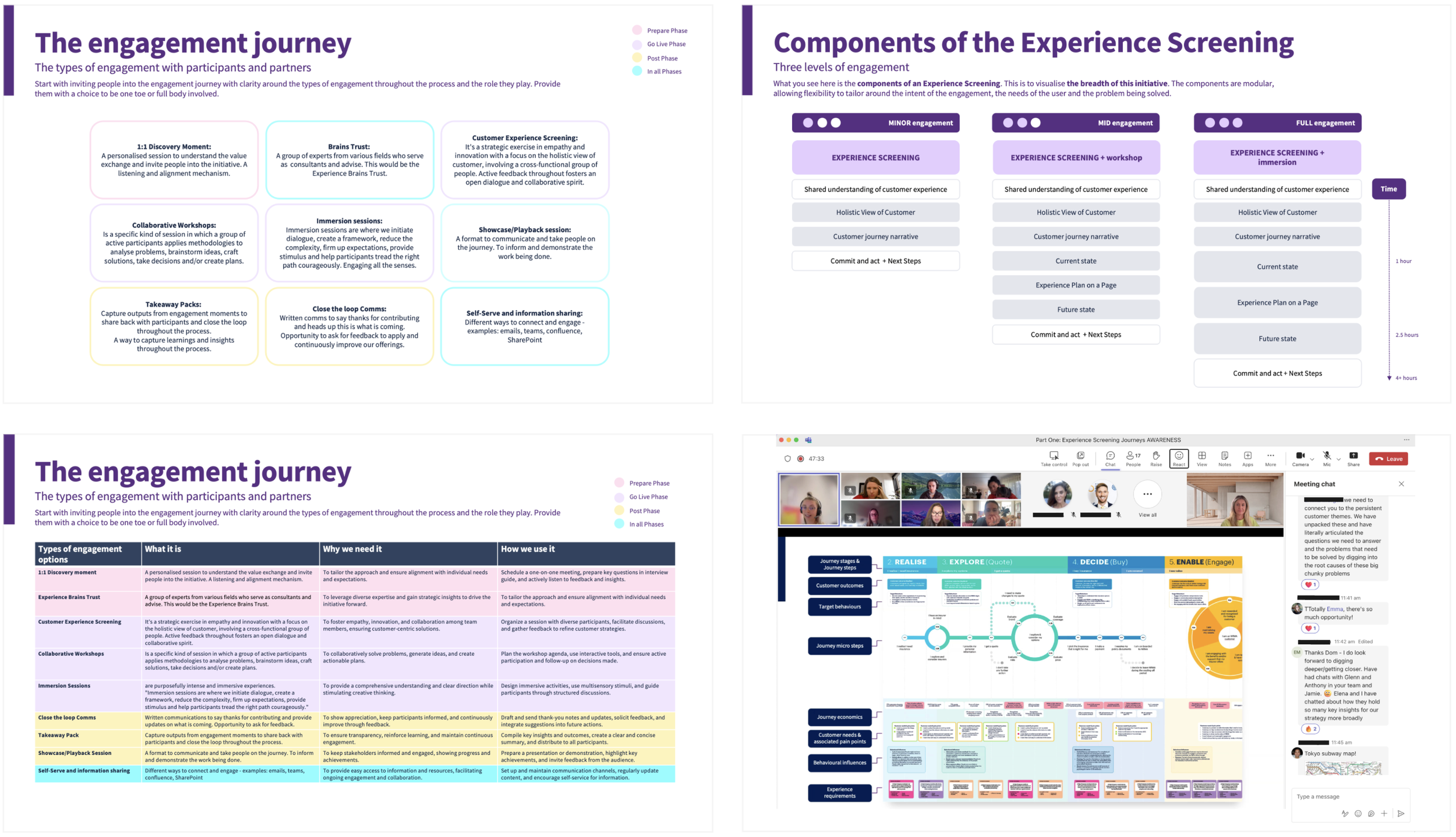
Experience Screening initiative for customer journeys embedment
CX movement to activate and enable a holistic view of customer
-
Journeys Audit: Conduct workshops to collect and organise existing work within key stages of the customer journey.
Research: Identify and gather insights from various internal and external sources.
Holistic View of Customer Review: Establish a knowledge wall and facilitate walkthroughs to uncover hidden content and ensure alignment on the Holistic View of Customer.
-
Sense-making: Synthesised research findings, language and practices across the three teams in Customer Strategy, Insights & Design into a Holistic View of the Customer.
Problem Identification: Framed the problem, opportunities, and questions to be addressed in the CX Movement and Experience Screening initiative.
Co-created the CSID Narrative: Collaborated core team on the UVP for the team using Simon Sinek 'Why. How. What' method.
Strategy to Delivery Framework: Developed the 'Connected View of Strategy and Delivery' framework to capture how the streams of work in the CSID team fit together and play a key role in bridging the gap between strategy and delivery.
Archetypes: Developed high-level key audience archetypes.
-
Visual Communication Tool: Created the 'CSID Sandwich' framework and visual tool to integrate and illustrate the alignment between customer strategy, design & journeys, and behavioural science, demonstrating the connection with delivery pathways.
Co-creation of the Experience Screening Initiative: Designed the structure and system for experience screenings, including modular engagement levels and supporting materials.
Engagement framework and strategy: Develop the engagement framework and strategy for embedding customer tools and frameworks.
Holistic View of Customer Ecosystem: Drafted the ecosystem map that captures strategic pillars and the components that need to exist and be true to enable the business to be customer and experience-centric.
Framework to uplift CX Maturity: Designed a framework around how the Customer Strategy, Insights and Design team can uplift CX maturity.
Feedback Loops: Implementing mechanisms for regularly collecting and acting on feedback.
Prototyping and Testing: Constantly experimenting with new ideas and refining them based on real-world feedback.
-
Customer Journeys Workshops: Facilitated engagement sessions and workshops to build Customer Journeys awareness and capability within the business.
Customer Journeys Offerings: Designed and delivered Journey offerings/modules are assets that can be used by the CSID team to share with the business.
CX Movement Engagement Journey: Implemented the engagement journey, inviting partners and participants to collaborate and contribute to the CX Movement.
Customer Journeys Embedment: Developed takeaway packs, feedback forms, and follow-up communications to ensure continuous improvement and engagement.
Immersion Space: co-created a physical space for the 'Wear & Tear' project team to exhibit their work to support with the Parliamentary Enquiry into the 2020 Lismore floods. Along side the project work the Holistic View of Customer and the CSID team approach to solving complex problems was created.
CX Movement Ecosystem: Established an experience-centric ecosystem to bring customers front of mind and at the heart of decision-making which is essential to delivering experiences that are consistently helpful, relevant, and adaptive to the changing needs of our customers.
Human-Centre Design (HCD): Integrated Design Thinking into organisational processes to create and sustain meaningful and memorable customer experiences.
Vision to Reality: Translated the CSID vision of ... into reality
Tangible outcomes are: a CSID story, a shared language that the team now have and use when talking about how we work together.
Impact
By uplifting customer experience maturity and embedding a holistic view of the customer, I, in collaboration with the Customer Strategy Insights & Design team, have increased customer engagement, fostered cross-functional collaboration, and empowered teams. This initiative has ensured strategic alignment and driven transformative change, embedding customer-centric decision-making into the core of our business culture. These efforts are pivotal in transitioning DIA from an insurance company to a help company, fostering a lasting sense of trust and security through exceptional customer support, and ensuring that customer experiences are consistently prioritised and refined.
Outcomes
Uplifting Customer Experience Maturity
Established a holistic view of the customer journey by creating knowledge walls and facilitating walkthroughs, ensuring team contribution and alignment. This led to the co-creation of the CSID narrative and the 'CSID Sandwich' visual tool, integrating customer strategy, design, journeys, and behavioural science to foster a holistic customer-centric point of view.
Creating an immersion space supported initiatives like the 'Wear & Tear' project for the Parliamentary Flood Enquiry. By integrating Human-Centred Design (HCD) into team processes, the CSID vision was translated into tangible outcomes, including a shared language for collaboration. This established an experience-centric approach crucial for consistently delivering helpful, relevant, and adaptive customer experiences.

Customer Experience Movement Ecosystem
The CX Movement drives transformative change by embedding and growing a strong CX environment. By drafting an ecosystem map that captures strategic pillars, this initiative creates clarity on what being customer centric looks like, ensures a customer and experience-centric approach, placing the customer at the core of every business decision and embedding this focus into the company's DNA.

Transformative CX Movement
Developed an engagement framework and strategy to embed customer tools and frameworks, created high-level audience archetypes, and a CX ecosystem map capturing strategic pillars.
Designed and delivered customer journey sessions and strengthened journey awareness through Experience Screenings. This created the foundations for the active embedment of journey-led, customer and experience-centric practices throughout the NRMA business.
Empowered and Collaborative Teams
Enhanced collaboration and shared language within the CSID team, leading to more dynamic and effective working methods. Facilitated workshops to build customer journey awareness, developed and delivered journey offerings, and established feedback loops for continuous improvement. These efforts empowered teams to work cohesively and creatively, supporting the transition to an experience-centric organisation.
“I’ve thoroughly enjoyed learning more about the customer journey. I’ve been fortunate leading the cx and content stream for the wear and tear piece of work from the persistent customer themes work to witnesses first hand the valuable work we can produce as a team when we cross collaborate... Look forward to working more closely with you all moving forward.”
Participant | Journeys AWARENESS, Experience Screening Initiative

Increased Customer Connection
Experience Screenings centred around the customer experience journey map further strengthened employees relationship and connection to customer.

“Our journeys have never been explained so clearly to onboard and excite teams to see the value in this. Thank you CSID (Customer Strategy, Insights & Design team).”
Participant | Executive Manager of Marketing
Strategic Alignment
Created the 'Connected View of Strategy and Delivery' framework to align strategy with delivery pathways, so that customer insights, pains and needs are consistently prioritised. This approach embedded customer journey tools and frameworks, effectively reinvigorating customer engagement and enhancing the overall experience.

Reflection:
This experience highlighted that customer experience must be integrated into the way we work rather than being viewed as an optional add-on. It's essential for driving meaningful and transformative change because customer focus is everyone’s responsibility. Integrating customer-centric tools and frameworks into the business requires a holistic and systemic approach. Establishing clear alignment and traceability between strategy and delivery pathways is challenging yet vital for ensuring that customer needs are consistently understood and prioritised. Additionally, fostering cross-functional collaboration and developing a shared language among teams facilitated more effective and dynamic ways of working.